What is CRM?
CRM (customer relationship management) is a category of tool that keeps customer records, purchase history, support enquiries and email or LINE open and click history in one place, and puts them to work in marketing, sales and support. Bringing that data together deepens your understanding of each customer and lets you make recommendations and send messages suited to each person.
In ecommerce, CRM is used above all to encourage repeat purchases based on who bought what and when. Being able to send messages automatically in response to customer behavior — abandoned cart follow-ups, back-in-stock alerts, birthday coupons — is one of the biggest benefits of adopting a CRM.
One place for customer data
Bringing together customer details, purchase history, wishlists, enquiries and responses to email and LINE removes the hassle of searching through information scattered across tools. Deciding which campaign to run for which customers gets faster, and marketing analysis and improvement become easier.
Stronger personalization
Purchase data lets you recommend products and send coupons suited to each customer. Compared with sending the same message to everyone, personalized messages tend to get better responses and lead to repeat purchases and long-term customer relationships.
More efficient customer support
Staff can check past enquiries and purchase history right away and respond with the customer's situation in mind. Sharing support history across the team makes it easier to keep quality consistent even when the person handling a case changes.
Example findings on the effects of CRM
Statistics on the effects of CRM compiled by an overseas company cite figures like these.
| Metric | Value cited in the research |
|---|---|
| Lead conversion rate | Up to 300% improvement |
| Customer satisfaction | 75% improvement |
| Sales productivity | Up to 40% improvement |
| Revenue | 29% increase |
| Customer retention | 27% improvement |
Source: Kixie, "CRM Statistics and Market Insights for 2025". The research spans industries and company sizes, so treat these as a rough guide for ecommerce.
Why connect a CRM to Shopify
Shopify has basic customer management, but as of November 2026 it does not include LINE messaging or full automated journeys based on purchase data out of the box. You can manage customer records and purchase history and build simple segments, but for more advanced campaigns stores usually add a Shopify CRM app or an external CRM.
Apps install without code
Shopify CRM apps are ready to use once installed from the Shopify App Store. No programming knowledge is needed, and you can keep your current theme. Some apps let you start checkout abandonment alerts, back-in-stock alerts, wishlist price-drop alerts and birthday messages just by swapping the images and text in a template.
External CRMs, on the other hand, offer advanced features but require you to set up the Shopify integration yourself, making them better suited to experienced teams.
Automated LINE and email notifications
As your customer count grows, sending LINE messages and emails by hand becomes a heavy load and raises the risk of sending the wrong message. If you prepare messages for abandoned carts, restocks, price drops and birthdays in advance and send them automatically when customers take an action, even a small team can follow up with every customer.
Back-in-stock, wishlist, LINE and other extensions
Installing an app adds features Shopify does not have by default. You can prevent lost sales from stockouts with back-in-stock alerts, tell wishlist users about price drops, or connect LINE to reach customers on a channel where messages are more likely to be opened.
Five Shopify CRM apps
First, here is a comparison of popular CRM apps you can install from the Shopify App Store. When choosing, check three things: the channels you want to use (email, LINE, SMS), the features you need, and the price for your customer count.
| App | Channels | Free tier | Back-in-stock and wishlist | Suits |
|---|---|---|---|---|
| Klaviyo | Email, SMS | Up to 250 active profiles | Back-in-stock supported; wishlist via another app | Mid-size to large stores selling overseas or focused on SMS |
| Omnisend | Email, SMS, web push | 500 emails/month to segments of up to 250 contacts | Combined with other apps | Stores wanting simple email marketing |
| ECPower | (Messages are sent through connected tools) | Free plan available | — | Stores wanting stronger customer analysis and segmentation |
| CRM PLUS on LINE | LINE | Up to 100 linked users | Back-in-stock supported | Stores wanting to go deep on LINE features |
| StoreCRM | Email, LINE | Up to 300 active customers | Built in | Stores in Japan that want email and LINE in one tool |
Pricing and free tiers reflect public information available as of November 2026. Check each service's official information for current details.
Klaviyo
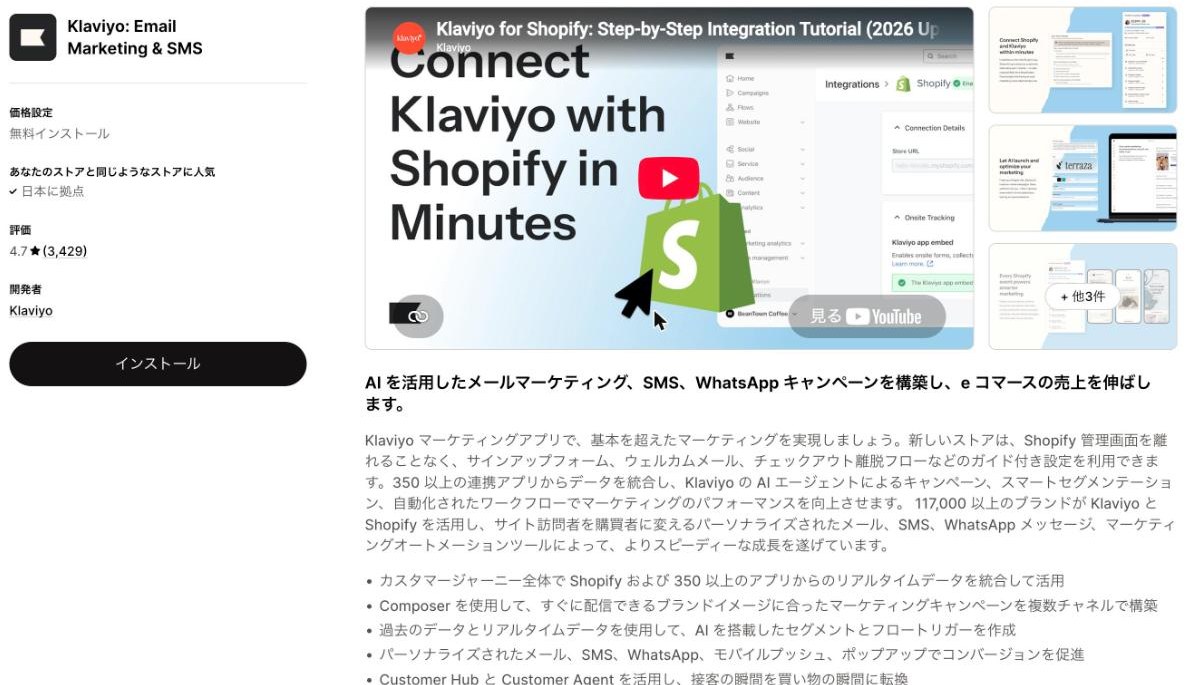
Source: Shopify App Store, "Klaviyo: Email Marketing & SMS" (viewed November 2, 2026)
An overseas email and SMS marketing app that pairs well with Shopify
Klaviyo is an email and SMS marketing app from the United States. It lets you build detailed segmented campaigns and automated flows from customers' purchase history and on-site behavior, and is used by many ecommerce businesses, mostly outside Japan.
Its built-in channels are email and SMS; LINE is not included. To use LINE, you combine it with a LINE integration service such as Lumo, which requires a separate contract and setup. Klaviyo is free for up to 250 active profiles and costs about $20/month for up to 500.
For features and pricing in detail, see What is Klaviyo? Features, pricing and caveats.
Omnisend
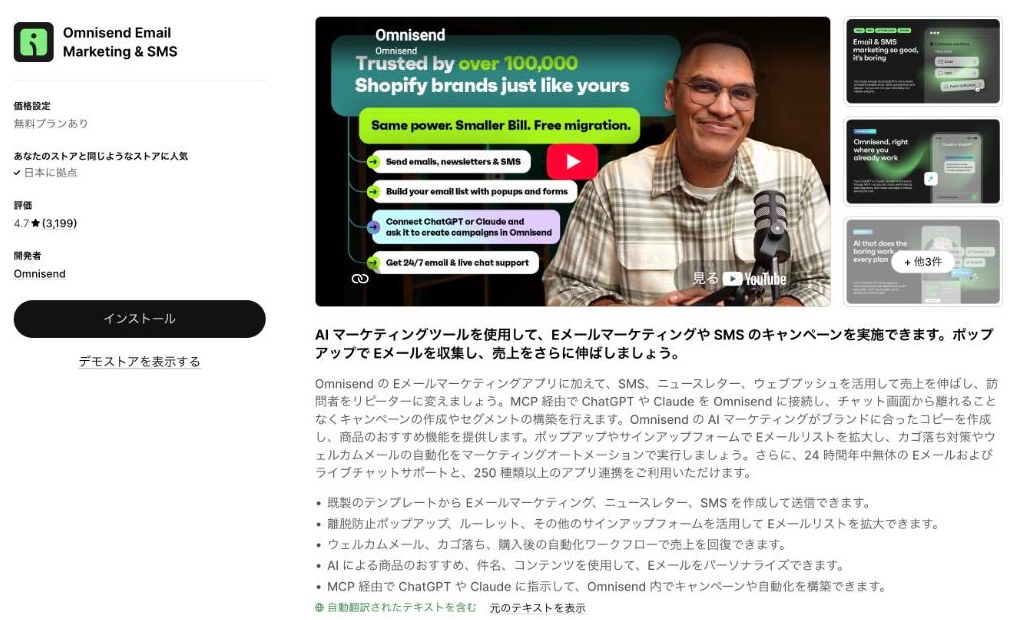
Source: Shopify App Store, "Omnisend Email Marketing & SMS" (viewed November 2, 2026)
An overseas email and SMS marketing app you can start for free
Omnisend is an email and SMS marketing app for ecommerce. With a wide range of templates and a drag-and-drop editor, you can start using automated journeys such as abandoned cart, welcome and birthday messages right away.
There are three plans: Free (up to 500 emails/month), Standard (from $16/month) and Pro (from $59/month). Since May 2026, SMS is used on the Pro plan through a separate credits subscription. According to its official information, LINE messaging is not a built-in feature.
For features and pricing in detail, see What is Omnisend? Features, pricing and caveats.
ECPower
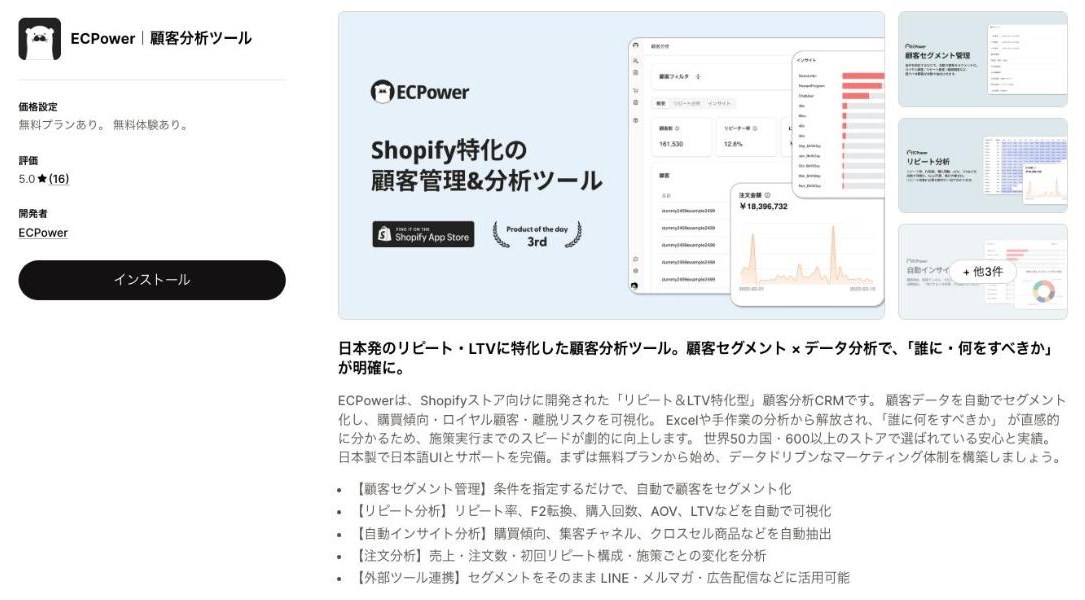
Source: Shopify App Store, "ECPower" (viewed November 2, 2026)
A segmentation and customer analysis app from Japan that connects with StoreCRM
ECPower is a segmentation CRM and customer analysis tool for Shopify developed in Japan, with a free plan available. You can build detailed customer segments by combining purchase count, total spend, purchase frequency, coupon use and tags, and check metrics such as LTV and repurchase interval on a dashboard.
ECPower is not a messaging tool itself, but when connected to StoreCRM it syncs the customer lists from your segments to StoreCRM for email and LINE campaigns. It suits stores that want to strengthen analysis and segmentation.
CRM PLUS on LINE
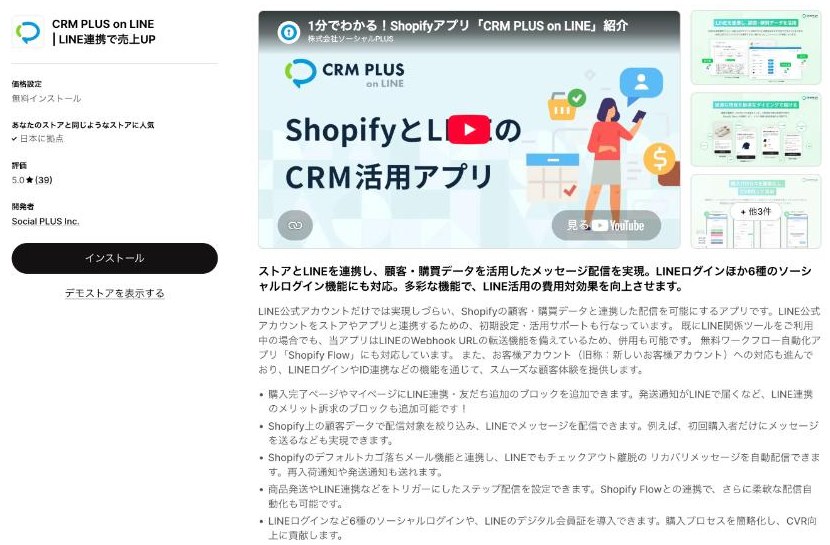
Source: Shopify App Store, "CRM PLUS on LINE" (viewed November 2, 2026)
An app from Japan dedicated to connecting Shopify and LINE
CRM PLUS on LINE is a LINE-focused Shopify app from SocialPLUS Inc. As of the end of December 2025, it was running on more than 2,500 stores. It links Shopify customers with LINE friends and sends LINE messages for abandoned carts, restocks, shipping and more. Automation is set up in combination with Shopify Flow.
Pricing is tiered by the number of linked users and is free for up to 100. Plans for Shopify Plus also include six social login providers including LINE, and a LINE mini app membership card.
For features and pricing in detail, see What is CRM PLUS on LINE? Features, pricing and caveats.
StoreCRM
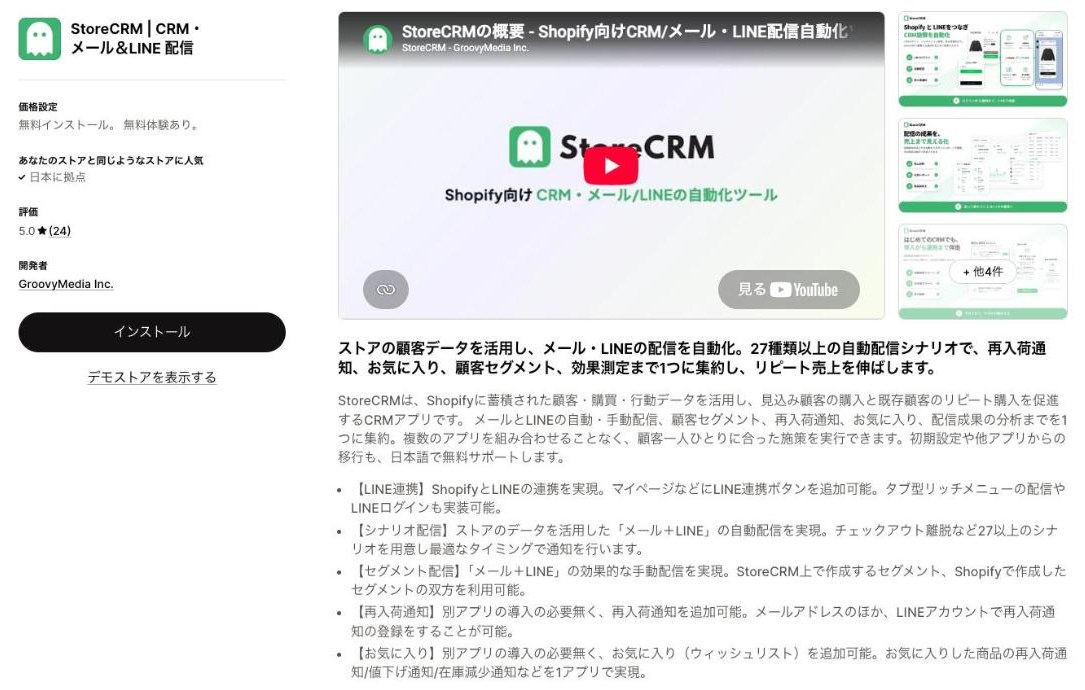
Source: Shopify App Store, "StoreCRM | CRM, email & LINE messaging" (viewed November 2, 2026)
A CRM app from Japan that sends email and LINE from one dashboard
StoreCRM is a CRM and marketing automation app built for Shopify stores in Japan. It sends email and LINE from the same dashboard, with a dashboard and support in Japanese. It connects Shopify customer data and purchase history and puts them to work in customer segments and automated journeys.
The app alone adds back-in-stock alerts and wishlists, and lets you set up restock and price-drop alerts for wishlisted products end to end. It also includes journeys that drive repeat purchases, such as reminders for unused coupons and messages for birthdays and first-purchase anniversaries. It supports LINE Login and tabbed LINE rich menus as well.
StoreCRM is free for up to 300 active customers, and the Standard plan costs $15/month for up to 500 — both with email and LINE. Paid plans come with a 30-day free trial. See prices by customer count on the pricing page.
Three external CRMs for Shopify
External CRMs take more work to set up and connect than Shopify apps, but offer full-scale features that extend into sales management and support. Choose by weighing the setup effort against the benefits, based on your products, company size and team setup.
| Service | Free plan | Japanese dashboard and support | Strengths |
|---|---|---|---|
| HubSpot | Yes | Yes | All-in-one for small to mid-size businesses; forms, landing pages, email and automation in one place |
| Salesforce | No | Yes | For enterprises; advanced automation, analytics and extensibility |
| Channel Talk | Yes | Yes | Focused on customer support; live chat, AI bot and LINE official account integration |
HubSpot
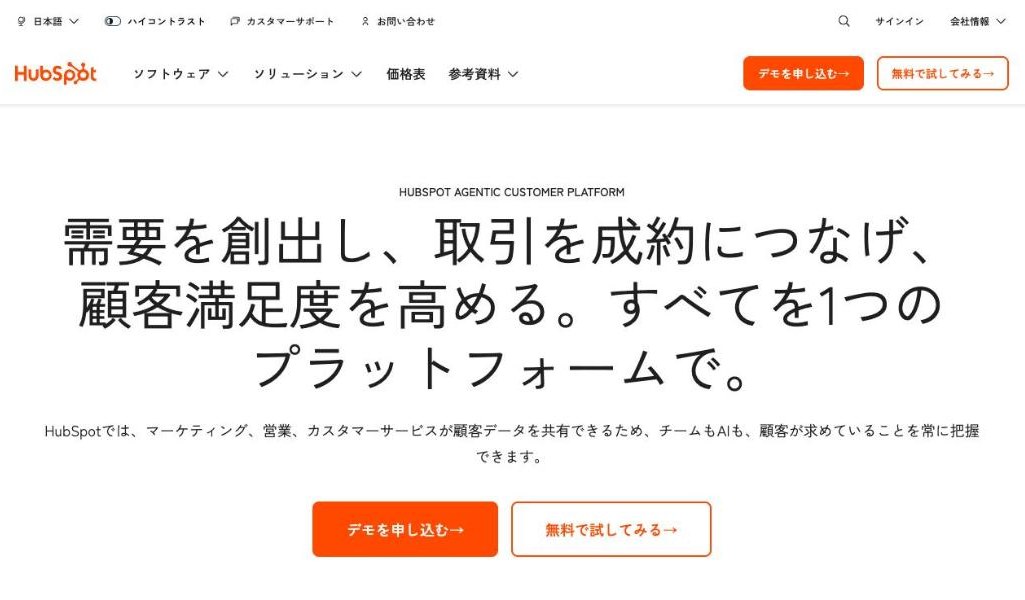
Source: HubSpot official website (viewed November 2, 2026)
An all-in-one CRM for small to mid-size businesses, with a free plan
HubSpot is an all-in-one CRM and marketing automation platform with a Japanese dashboard and support, available from a free plan. Connected to Shopify, it syncs customer and order information while managing your marketing in one place.
It includes forms, landing pages, pop-ups, and workflows that automate actions such as sending emails based on conditions. The HubSpot Shopify app makes it easy to add the basics, but serious use assumes running it in the main HubSpot platform.
Salesforce
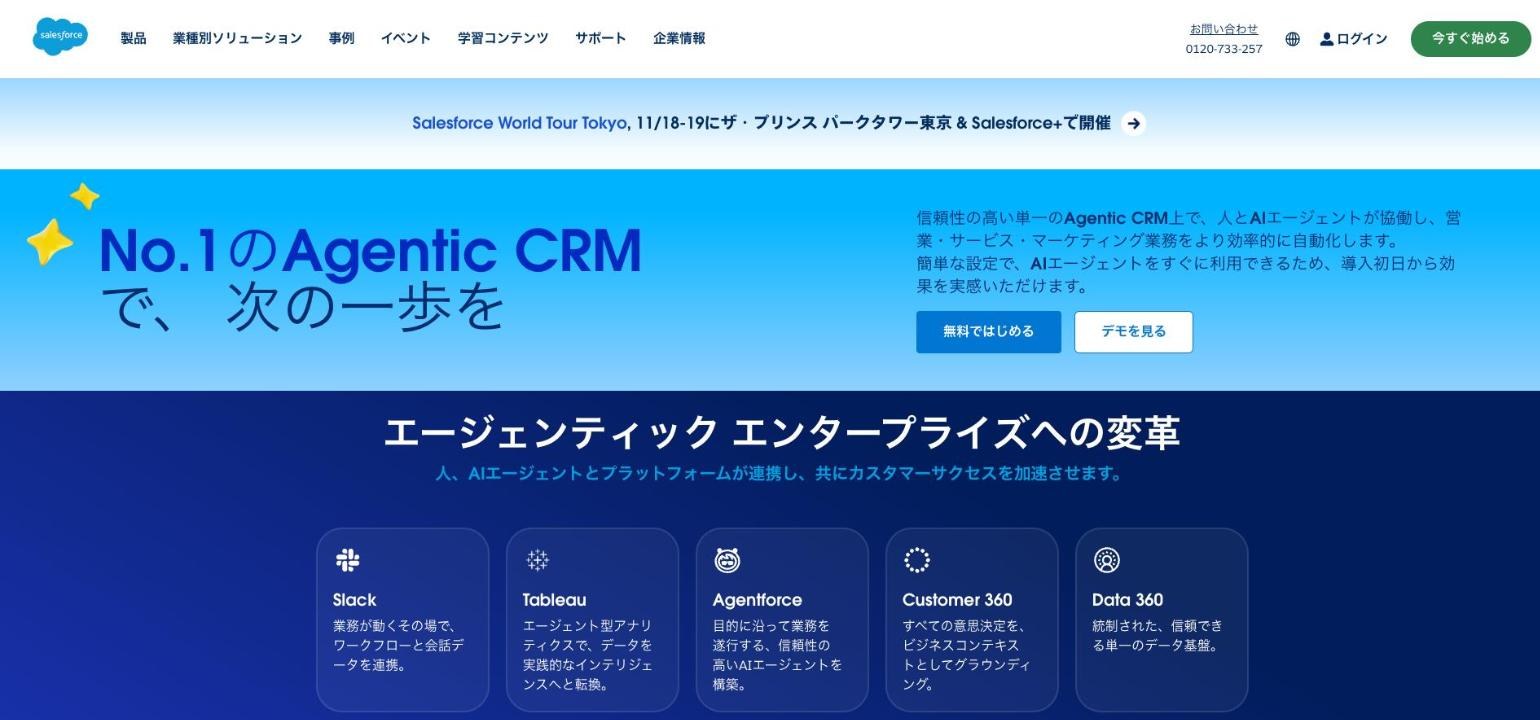
Source: Salesforce official website (viewed November 2, 2026)
An enterprise CRM built for large-scale operations
Salesforce is an enterprise CRM and marketing automation platform with a Japanese dashboard and support. There is no free plan and adoption costs are relatively high, but centered on Marketing Cloud it covers email, forms, landing pages and automated journeys with conditional branching.
To connect it with Shopify, you can sync data simply with the Salesforce Sync app, or sync customer and order data through a Data Cloud connector. It suits large ecommerce businesses and companies running comprehensive marketing across channels.
Channel Talk
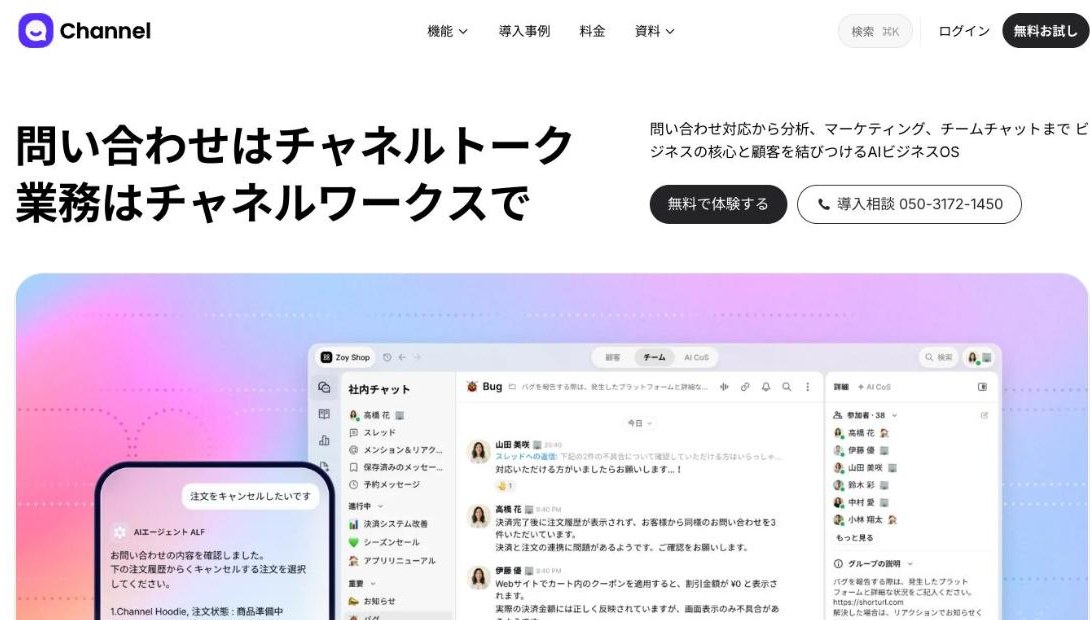
Source: Channel Talk official website (viewed November 2, 2026)
A chat-based CRM focused on customer support
Channel Talk is a customer-support-focused CRM from South Korea with a Japanese dashboard and support. It has a free plan and includes live chat, team chat, an AI chatbot and workflow automation.
Connected to Shopify, it syncs customer and order information into chats so you can quickly handle order and delivery questions. It suits stores that prioritize efficient support and customer satisfaction over marketing campaigns.
How to choose
Ways to add CRM to Shopify fall broadly into Shopify apps and external CRMs.
- Stores selling mainly overseas that want to make full use of email and SMS: Klaviyo, Omnisend
- Stores that want to go deep on LINE features: CRM PLUS on LINE
- Stores that want stronger customer analysis and segmentation: ECPower (sending through StoreCRM)
- Companies that want to handle customer data across sales and support: HubSpot, Salesforce, Channel Talk
- Stores in Japan that want to run email and LINE from one dashboard: StoreCRM
StoreCRM is free for up to 300 active customers, and paid plans come with a 30-day free trial. To check whether it fits your store, you can also download our product guide, which covers features and pricing.
Information in this article is current as of November 2026. Pricing and features of each service may change.