
+CLOTHET is the apparel brand of STYLEM Ltd., a textile trading company with more than 160 years of history. It launched as a D2C brand selling primarily through ecommerce, and as its customer base grew the team wanted to get serious about automated email campaigns driven by CRM and MA tools — which is why they adopted StoreCRM. [1] [2]
+CLOTHET has always been strong at marketing built around its email newsletter. Last year the brand began sending automated journeys with StoreCRM, and revenue from email and social has grown to 150% of the same month a year earlier. More recently the team has started sending newsletters to specific customer segments through StoreCRM, with striking results. [3] [4]
[1] CRM: a way of centralising customer information, strengthening relationships through better-targeted communication and maximising revenue.
[2] MA: a way of automatically delivering information at the right moment, based on the behavioural data of prospective customers.
[3] Automated journey: a staged series of emails sent automatically according to a customer's behaviour and attributes.
[4] Customer segment: a group of customers sharing common characteristics or conditions.
Interviewee
STYLEM Ltd.
Business Headquarters, Second Business Division, Garment Department 3
Manager, +CLOTHET Section
Toshio Okada
— Tell us about +CLOTHET.
We started out as a textile trading company: our main business is selling fabric to Japanese apparel companies and overseas brands. I spent close to 20 years myself on that side, supplying fabric to apparel makers.
Along the way we began to think that we wanted to launch our own brand and deliver directly to customers, and seven years ago we started +CLOTHET. The original idea was to take high-quality fabrics selected from around the world and put them straight into customers' hands.
— What makes +CLOTHET distinctive?
Above all, our commitment to materials. Given the company's history, we have the advantage of being able to source raw materials from suppliers all over the world, and delivering that quality D2C — good things at an accessible price — is the brand's single biggest selling point.
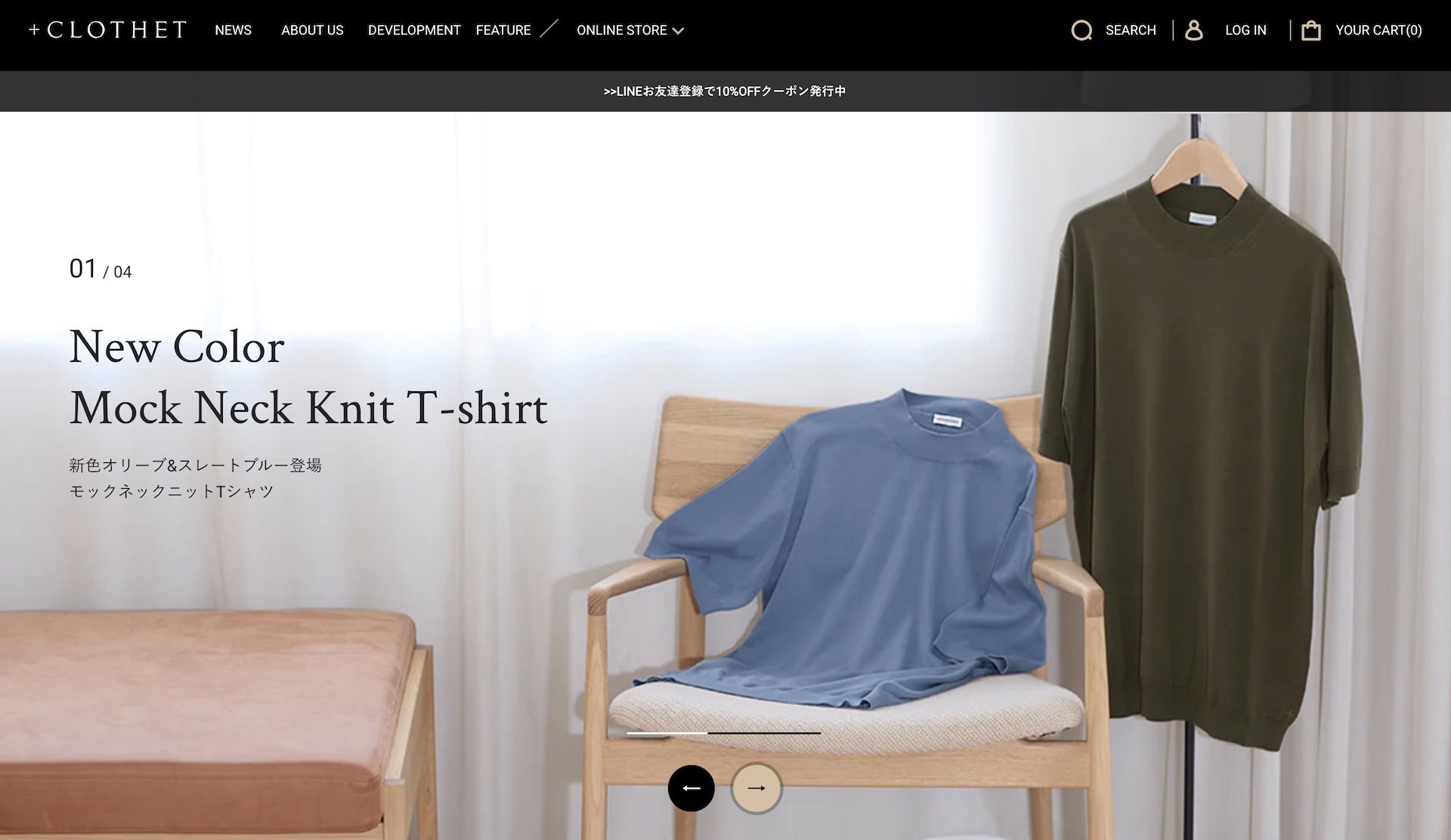
The +CLOTHET website
— Why did you set the brand up as a D2C business?
Simply selling fabric to apparel companies would have been no different from the business we already had. If we were going to do it, we needed to get better materials to customers while keeping the cost base down as far as possible. So we decided to keep physical stores to an absolute minimum, avoid costs such as store staffing, and build the business around ecommerce.
— What did you weigh up when you launched the store, and why did you choose Shopify?
At the time we were choosing, Shopify was not as mainstream as it is now and there was very little information available in Japanese. But the low upfront cost and the sheer variety of apps we could extend it with were appealing, so we started with it on a trial basis. It took some nerve to launch on Shopify back then, but in hindsight it was the right call.
Because we planned to run the brand without stores, the hard part was working out how to convey the quality of the materials, the care that goes into them and the story behind them, when customers cannot pick the product up.
— You are known for being strong at email newsletter marketing. What is your approach?
The top priority is never breaking the consistency of the brand's philosophy and mood. It is a little hard to put into words, but this is an earnest brand, and we are always thinking about keeping that consistent.
On timing: some brands send email every day, but at +CLOTHET we only send when we have something we believe customers will genuinely benefit from.
When the brand launched we had few products, so we sent once a week. As the brand has grown and we have more products and content, that has risen to two or three times a week — but the policy is still to send only when we have something worth saying.
We review performance weekly and monthly, looking at open rate, click rate and revenue from conversions.
— What was your impression of CRM and MA tools before you adopted one, and what changed afterwards?
We knew tools like this existed and we wanted to use one, but we assumed they would not be effective until we had a reasonably large audience to send to.
At around the five-year mark for the brand, we decided it was time to start running CRM and MA campaigns such as automated journeys. Email is still the channel that generates the most conversions for +CLOTHET, so this was also about strengthening that.
When we decided to adopt StoreCRM, we had only just got as far as segmenting our customers, looking at the results and thinking "so this is who our customers are — I would like to grow revenue from this segment." After installing StoreCRM, it became a question of how we could win back lapsed customers under our own steam, using approaches such as RFM analysis. [5]
[5] RFM analysis: a method of evaluating and classifying customers by the recency, frequency and monetary value of their purchases.
Last month we ran a segmented campaign for the first time, targeting people who had not bought from us yet this year, and it converted far better than we had expected. Compared with a standard newsletter, the click rate on links in the email was 2.6 times higher and CVR was 4.5 times higher, so we are really feeling the impact of segmented sending. We plan to repeat it.
We currently have around five automated journeys running. One characteristic of +CLOTHET is that a certain number of customers make their second purchase the following month or the month after — faster than at other companies — so we are using automation to push that further.
For example, we send a thank-you email two weeks after purchase with content on how to care for and wash the item, and it often leads to another purchase. Creating those small touchpoints really does matter. [6]
[6] Thank-you email: an email of thanks sent automatically straight after a purchase or sign-up.
With birthday emails, we send the first one at the start of the month and a second on the 25th, only to people who have not yet used the coupon from the first. That second email picks up a lot of purchases customers would otherwise have forgotten about — revenue is 40% higher than when we do not send it.
Revenue from email and social is now 150% of the same month last year. Revenue from advertising is falling while email and social grow, and StoreCRM is a big part of that increase.
Revenue attributed to StoreCRM is five times what it was a year ago, because we have become much better at running the journeys properly.
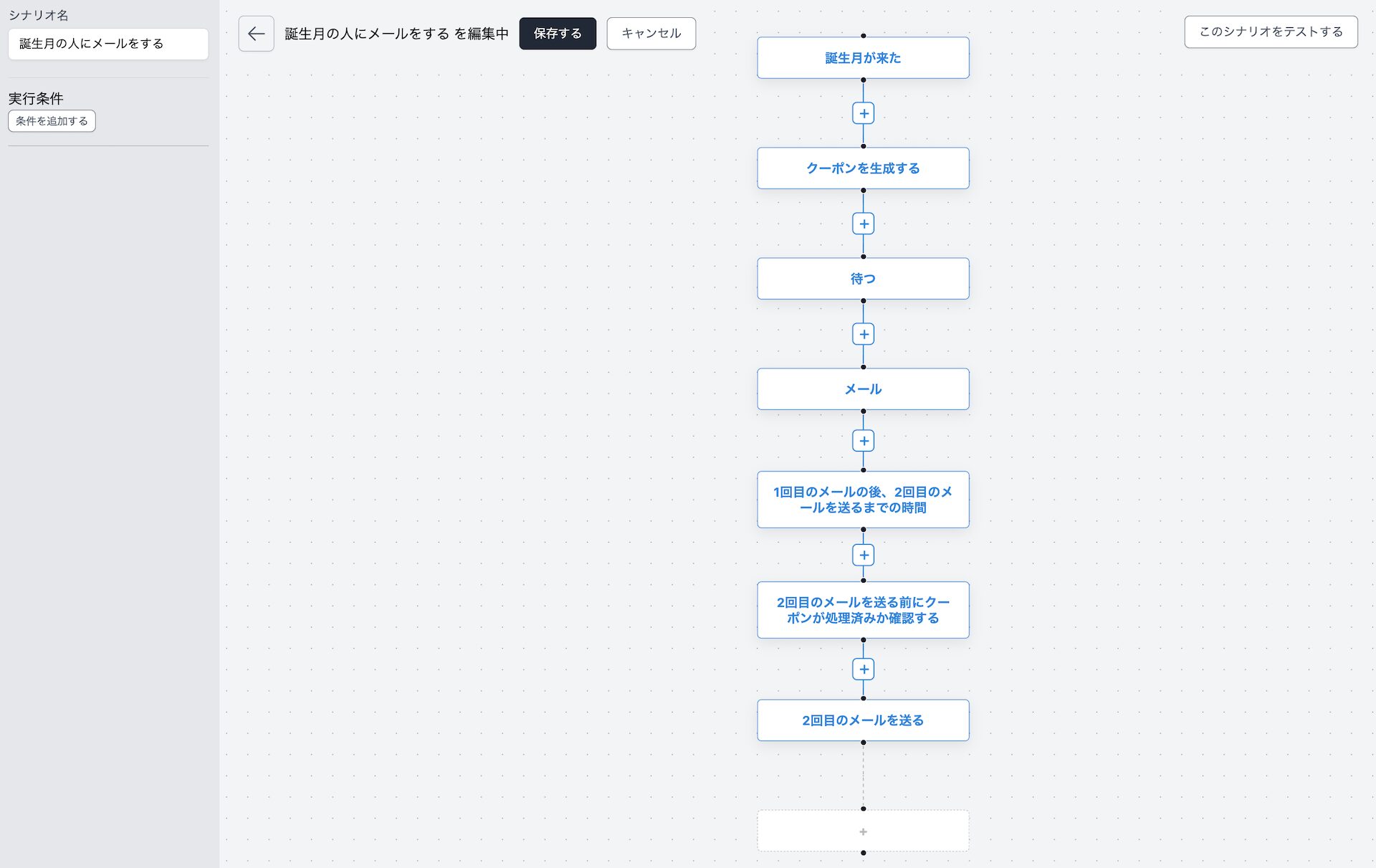
The birthday email journey +CLOTHET built in StoreCRM. An email goes out on the first day of the customer's birthday month, and a second follows on the 25th if the coupon has not been used.
— Are you doing anything to improve LTV? Has it changed?
Honestly, I understood the concept, but until now we had not done anything to improve LTV. We have since made it a focus, though, and we watch the numbers closely. LTV has doubled compared with three or four years ago, and it has become an important metric for us. [7]
[7] LTV: a measure of the cumulative profit or revenue a customer brings to a business over the course of the relationship.
For example, customers who come to our offline events have an LTV around 1.5 times higher than those who do not. Using CRM, we have built journeys that suggest complementary items to customers who bought a T-shirt, show them other sizes and cuts, or recommend trousers to go with a knit they have purchased. In ecommerce we cannot make those recommendations face to face, so we run these journeys as our way of growing LTV.
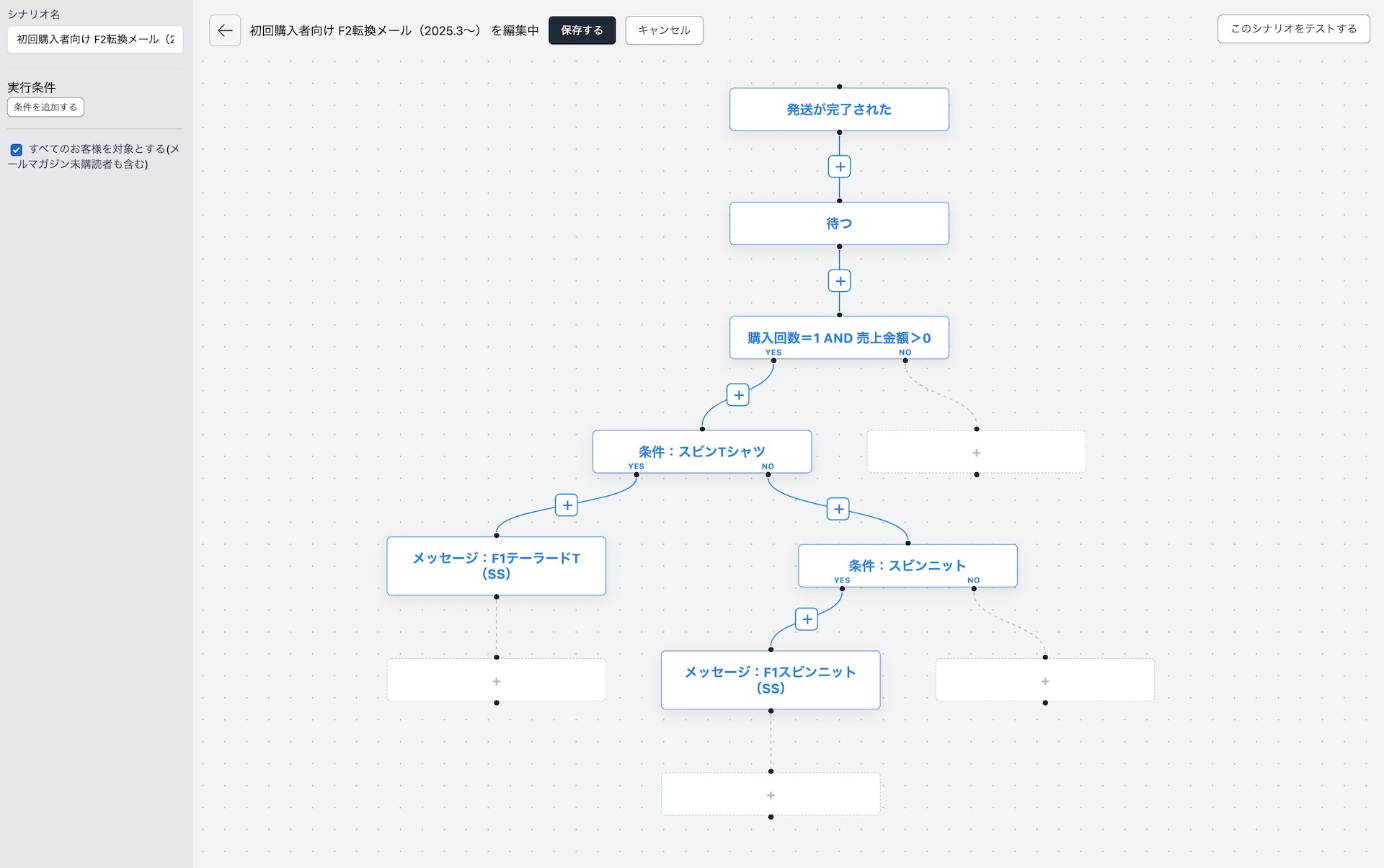
The journey +CLOTHET built for first-time buyers. The email a customer receives depends on the product they purchased.
— Now that you have been running CRM and MA campaigns for a while, how has your relationship with customers changed?
Honestly, at the start I wondered whether it would really have that much impact. As a customer myself, I do not pay much attention when emails keep arriving, so I was not sure what to expect. Once we actually started running it, the response was very good. We do not send all that often, and even so the effect was clearly visible — that was encouraging.
I also feel the distance between us and our customers has narrowed. We deliberately keep the content close to the customer, covering things like product care, so we would like to keep adding journeys in the same vein.
We run offline events a few times a season, and some of the customers who come along have seen our emails; the reactions are positive. CRM has become a real strength for the brand in terms of building relationships with customers, too.
— What are you doing on LINE?
When the brand started we were not especially active on LINE, but as part of strengthening our CRM work we decided to grow the number of friends on our LINE official account. Our customers skew male, and we had a hypothesis that more of them were using LINE than email, so we ran campaigns to encourage friend adds.
We still have more subscribers on email, but on revenue alone LINE has come very close to it. So we send on LINE just as we do on email, and we make a point of refreshing the rich menu regularly.
— With advertising costs moving as they have recently, has the importance of CRM changed?
We have increased overall ad spend by about 20% compared with before, but CPA has risen — this may be a global effect — and the results have not matched the extra budget. We put 80% of the budget into acquiring new customers, and that is exactly where returns have thinned out and we are struggling. [8]
[8] CPA: cost per acquisition — the advertising cost of winning a single conversion.
On the other hand, from this year CRM has come to be treated as one of the three pillars of our marketing and promotion, alongside advertising and the newsletter. Two years ago we were not running CRM campaigns at all and had nobody assigned to it; today we have one person dedicated to sending the newsletter and managing the apps.
— Are there CRM campaigns you would like to run in future?
Honestly, I think we have only just started. We are nowhere near using every feature or getting the full potential out of the tool, but I would like to work on winning back customers who have lapsed, and on deepening relationships with the customers we meet offline.

Fabric samples line an entire wall of STYLEM's Tokyo office.